

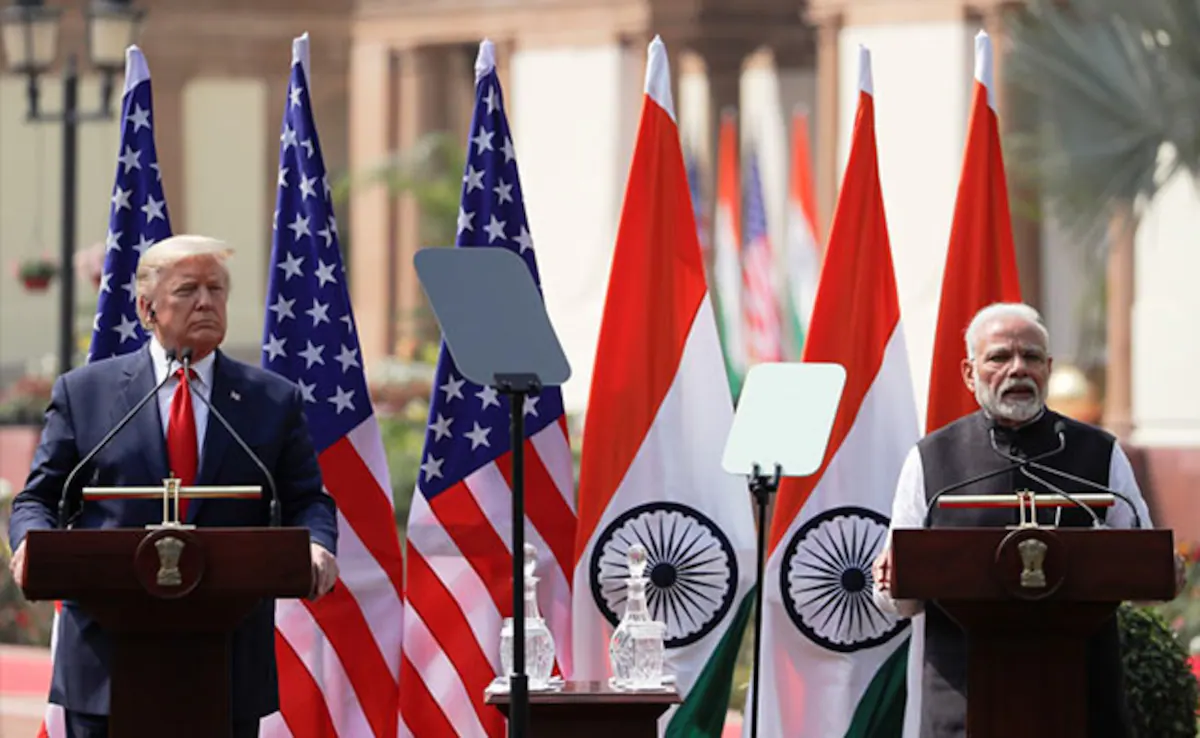
A decision by Donald Trump to sharply reduce US tariffs on Indian imports sparked a relief rally across Indian financial markets on Tuesday, buoying exporters and policymakers despite the lack of clarity surrounding the agreement.
Trump said on Monday that Washington would lower tariffs on Indian goods to 18 percent from 50 percent after New Delhi agreed to halt purchases of Russian oil and ease trade barriers. The announcement was made via social media following talks with Indian Prime Minister Narendra Modi.
However, neither the White House nor the Indian government has released a detailed breakdown of the deal’s scope, timeline or enforcement mechanisms.
Markets React as Export Outlook Improves
Indian equities and the currency strengthened on the news, reflecting optimism that lower tariffs could restore competitiveness for exporters. The benchmark Nifty 50 rose nearly 3 percent in early trade, while the rupee gained more than 1 percent to 90.40 per dollar.
“India’s tariff agreement with the US removes a key disadvantage compared with regional peers,” said Neelkanth Mishra, chief economist at Axis Bank.
He said the move would benefit export-oriented sectors such as gems and jewellery, leather goods, plastics, ceramics, auto components and non-technology foreign investment.
US tariff rates on other Asian exporters currently stand at around 19 percent for Indonesia and 20 percent for Vietnam and Bangladesh, placing India broadly in line with its competitors.
Trade Flows and Policy Response
According to Indian government data, India’s exports to the United States rose nearly 16 percent year-on-year to $85.5 billion in the January–November period, while imports totalled $46.08 billion.
India’s economic affairs secretary, Anuradha Thakur, said the agreement had eased a significant amount of global uncertainty and helped lift investor confidence.
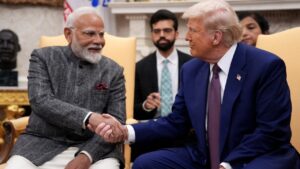
“Lower tariffs will not only improve price competitiveness but also help Indian exporters integrate more deeply into US supply chains,” said S.C. Ralhan, president of the Federation of Indian Export Organisations.
Ratings agency Moody’s Ratings said the reduction in US tariffs on most Indian goods would help reinvigorate exports to the American market.
Deal Still Lacks Specifics
Despite public statements from Trump and Modi, many elements of the agreement remain undefined. An Indian government official said New Delhi has agreed to buy US petroleum, defence equipment and aircraft, and to partially open its closely guarded agriculture sector.
India has also lowered tariffs on imported vehicles to address immediate US demands, the official said.
Trump has claimed that India will increase purchases of American goods to more than $500 billion, including energy, coal, technology and agricultural products, but did not specify a time frame.
Russian Oil Question Unresolved
Uncertainty also surrounds India’s commitment to end imports of Russian oil. According to Reuters, Indian refiners would require a transition period to wind down existing contracts and have not yet been formally instructed to halt purchases.
The Kremlin said it had received no official communication from India indicating a shift away from Russian oil.
Moody’s warned that an abrupt end to Russian oil imports could disrupt India’s economic growth, tighten global supply and raise inflation, given India’s position as one of the world’s largest oil importers.
Agriculture Remains Sensitive
US Agriculture Secretary Brooke Rollins said the deal would open India’s vast market further to American farm products, though no specifics were provided.
Historically, India’s trade agreements have excluded several sensitive agricultural and dairy products, as the government seeks to protect millions of small-scale and subsistence farmers.
For now, investors appear willing to focus on the immediate tariff relief, even as questions remain over how — and when — the broader trade commitments will be implemented.