

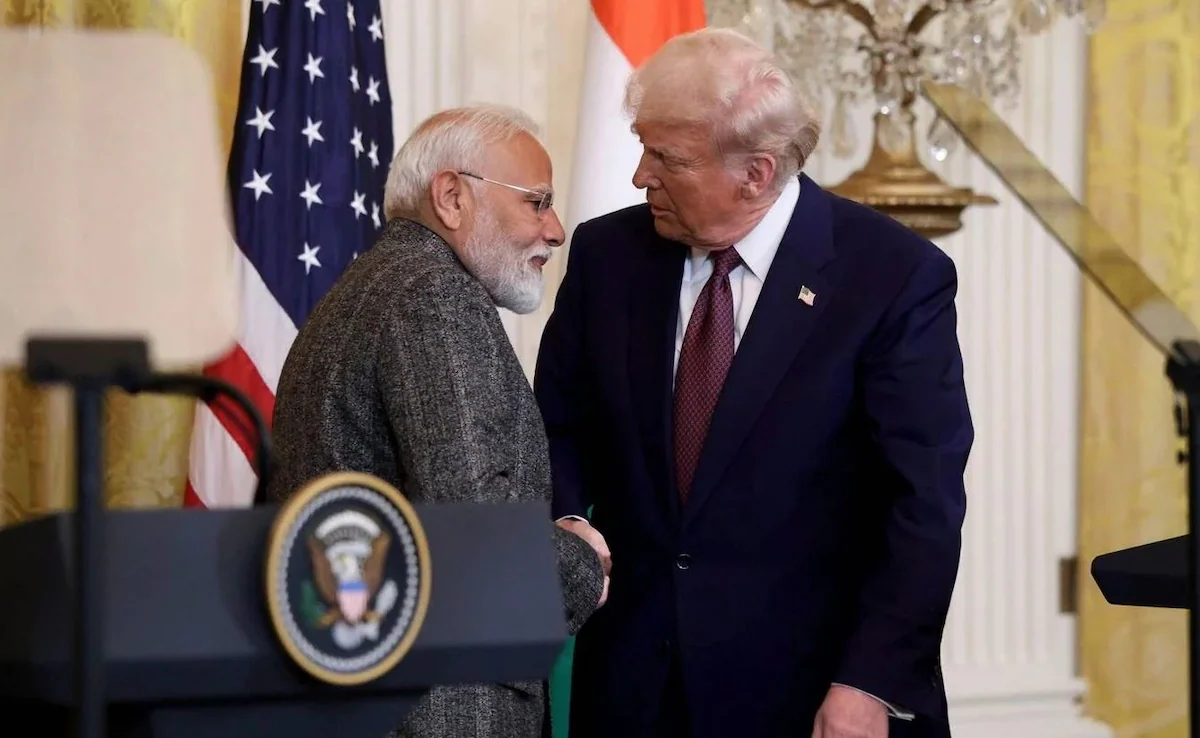
The United States will sharply reduce tariffs on India goods to 18 percent from 50 percent after India agreed to stop buying Russian oil and ease trade barriers, US President Donald Trump announced on Monday.
Trump said the agreement was reached following a call with Indian Prime Minister Narendra Modi, adding that India would now shift its energy purchases toward the United States and potentially Venezuela.
According to a White House official, Washington will also remove a punitive 25 percent duty imposed on Indian imports over New Delhi’s purchases of Russian oil. That surcharge had been added on top of a separate 25 percent “reciprocal” tariff.
Markets Rally on Trade Relief
The announcement triggered a sharp rally in US-listed Indian stocks. Shares of Infosys rose 4.3 percent, Wipro gained 6.8 percent, and HDFC Bank climbed 4.4 percent. The iShares MSCI India ETF advanced about 3 percent.
The deal also supported broader market sentiment, adding to gains driven by optimism around semiconductor makers and artificial intelligence stocks.
Commitments on Energy and Trade Barriers
Trump said Modi had pledged that India would “buy American at a much higher level,” including more than $500 billion worth of US energy such as oil and coal, along with technology, agricultural products and other goods.
India also committed to cutting both tariff and non-tariff barriers on US products, Trump said, claiming these would eventually be reduced to zero.
Before Trump returned to office and raised tariffs last year, India maintained some of the highest import duties globally, with a simple applied tariff rate of 15.6 percent and an effective rate of 8.2 percent, according to World Trade Organization data.
Details Still Unclear
Despite the market reaction, key aspects of the deal remain unspecified. Trump did not indicate when the lower tariff rates would take effect, set a deadline for India to fully halt Russian oil purchases, or clarify which US products would benefit most.
As of late Monday, the White House had not issued a presidential proclamation or published a notice in the Federal Register to formally implement the changes. India’s commerce and foreign ministries, as well as Russia’s embassy in Washington, did not immediately comment.
Unlike recent US trade agreements with Japan and South Korea, the India deal did not include commitments for large-scale investment into US industries.
Madhavi Arora, an economist at Emkay Global, said the agreement brings India broadly in line with Asian peers whose tariff rates range between 15 and 19 percent, easing pressure on Indian exports and the rupee.
Business Groups React Cautiously
Indian markets have struggled since Washington imposed the tariffs, making India the worst-performing emerging market in 2025 as foreign investors pulled out record amounts of capital.
US business groups offered mixed reactions. The US Chamber of Commerce said the announcement marked progress toward a more open trade relationship.
Chamber chief executive Suzanne Clark said the group hoped the deal would lead to a comprehensive agreement unlocking deeper private-sector cooperation.
However, a coalition of more than 800 small businesses known as We Pay the Tariffs criticised the deal, arguing that an 18 percent tariff still represents a steep increase from the 2 to 3 percent rates that applied in 2024.
Indian Leaders Welcome Deal
Modi welcomed the agreement in a social media post, thanking Trump for lowering tariffs on Indian-made products and calling it a boost for India’s 1.4 billion people.
India’s Trade Minister Piyush Goyal said the deal would strengthen economic ties and create new opportunities for farmers, small businesses and skilled workers, while helping India access US technology.
The agreement follows India’s recent trade deal with the European Union, which is expected to eliminate or reduce tariffs on nearly all traded goods, though some agricultural products were excluded.
Oil Shift Away From Russia
The deal also reflects Washington’s push to curb India’s reliance on Russian energy. India, the world’s third-largest oil importer, depends on imports for roughly 90 percent of its needs and has benefited from cheaper Russian crude since Moscow’s invasion of Ukraine.
India has already begun reducing those purchases. Imports from Russia fell to about 1.2 million barrels per day in January and are expected to decline further in the coming months, according to Reuters.
Trump has also suggested India could offset Russian supplies by buying oil from Venezuela, adding another geopolitical dimension to the agreement.